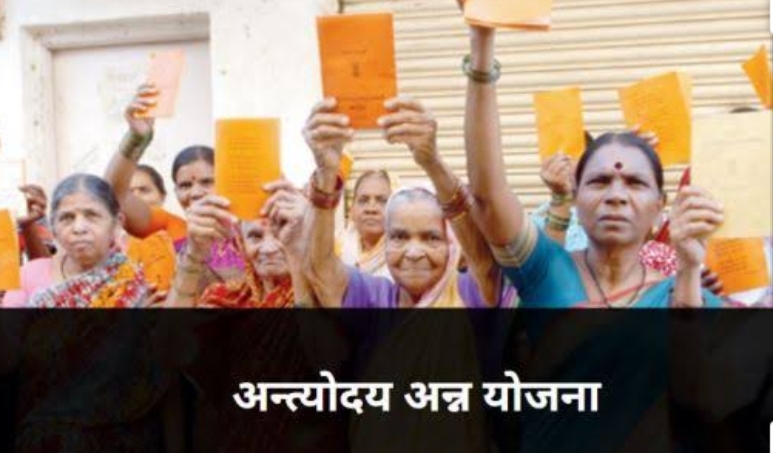
A National Sample Survey Exercise pointed out that about 5% of the total population in India sleeps without two square meals a day. The Public Distribution System (PDS) later revamped to the Targeted Public Distribution System (TDPS) aimed at providing food and grains to the needy. To make the TPDS more beneficial and more focussed towards the right category of population, the Antyodaya Anna Yojana (AAY) was launched in December 2000. AAY is the Government scheme that was launched to provide highly subsidised food to one crore poorest of the poor families in India.
Features of the Antyodaya Anna Yojana
- AAY had to first identify one crore poorest of the poor families from amongst the Below Poverty Line (BPL) families covered under the TPDS within the states.
- Provide them grains at a highly subsidised rate of Rs. 2 per kg for wheat and Rs. 3 per kg for rice and Re. 1 for coarse grains.
- All costs related to distribution, transportation, and also margins of dealers had to be borne by States/UTs.
- The chosen households are entitled to 35kg of food grains per month.
- The number of poor households has since increased to 2.5 crores and also includes households headed by terminally ill or widows or disabled persons or persons aged 60 years and above and no means of subsistence.
Eligibility Criteria for Antyodaya Anna Yojana
To identify the households that are eligible for the benefits of the scheme, the guidelines stipulated the following criteria:
- Agriculture labourers without lands, marginal farmers, rural artisans or craftsmen, like weavers, blacksmiths, carpenters, potters, tanners, slum dwellers, and daily wage earners in the informal sector like cobblers, rag pickers, snake charmers, porters, coolies, rickshaw pullers, hand cart pullers, fruit and flower sellers, destitute and other similar types in both rural and urban areas.
- Households that are headed by terminally ill persons/disabled persons/ persons aged 60 years or more or widows with no assured means of subsistence or societal support.
- Persons who are terminally ill or widows or disabled persons or persons aged 60 years or more or single women or single men with no family or societal support or assured means of subsistence.
- All tribal households which are primitive
- .
AAY was a step in the direction of making TPDS aim at reducing hunger among the poorest segments of the BPL population. A National Sample Survey Exercise pointed towards the fact that about 5% of the total population in the country sleeps without two square meals a day. This section of the population could be called as “hungry”. In order to make TPDS more focused and targeted towards this category of population, the “Antyodaya Anna Yojana” (AAY) was launched in December, 2000 for one crore poorest of the poor families.
AAY involved identification of one crore poorest of the poor families from amongst the number of BPL families covered under TPDS within the States and providing them food grains at a highly subsidized rate of Rs.2/- per kg. for wheat and Rs.3/- per kg for rice. The States/UTs were required to bear the distribution cost, including margin to dealers and retailers as well as the transportation cost. Thus the entire food subsidy was passed on to the consumers under the scheme.
The scale of issue that was initially 25 kg per family per month was increased to 35 kg per family per month with effect from 1st April 2002.
The AAY Scheme has since expanded to cover 2.50 crore poorest of the poor households as follows: The AAY Scheme was expanded in 2003-04 by adding another 50 lakh BPL households headed by widows or terminally ill persons or disabled persons or persons aged 60 years or more with no assured means of subsistence or societal support. Order to this effect was issued on 3rd June, 2003. With this increase, 1.5 crore (i.e. 23% of BPL) families were covered under the AAY.
As announced in the Union Budget 2004-05, the AAY was further expanded by another 50 lakh BPL families by including, inter alia, all households at the risk of hunger. Order to this effect was issued on 3rd August 2004. In order to identify these households, the guidelines stipulated the following criteria:-a) Landless agriculture labourers, marginal farmers, rural artisans /craftsmen, such as potters, tanners, weavers, blacksmiths, carpenters, slum dwellers and persons earning their livelihood on daily basis in the informal sector like porters, coolies, rickshaw pullers, hand cart pullers, fruit and flower sellers, snake charmers, rag pickers, cobblers, destitute and other similar categories in both rural and urban areas.b) Households headed by widows or terminally ill persons/disabled persons/ persons aged 60 years or more with no assured means of subsistence or societal support.c) Widows or terminally ill persons or disabled persons or persons aged 60 years or more or single women or single men with no family or societal support or assured means of subsistence.d) All primitive tribal households.
As announced in the Union Budget 2005-06, the AAY was expanded to cover another 50 lakh BPL households thus increasing its coverage to 2.5 crore households (i.e. 38% of BPL). Order to this effect was issued on 12th May, 2005.